
Why the High Intensity Sweetener Market is Surging: Key Growth Factors
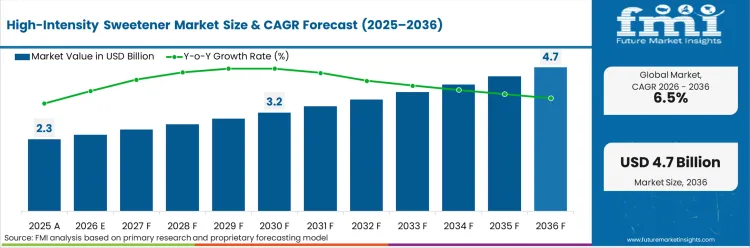
High-Intensity Sweetener Market Outlook
The global high-intensity sweetener market share is entering a decisive decade of measured but resilient expansion, underpinned by health-conscious consumption patterns and structural reformulation across food and beverage portfolios. According to insights from Future Market Insights (FMI), the market surpassed a valuation of USD 2,388 million in 2025. Demand is projected to reach USD 2,543 million in 2026 and further accelerate to USD 4,776 million by 2036, reflecting a CAGR of 6.5% over the forecast period.
This translates into an absolute dollar opportunity of nearly USD 2.4 billion over the next decade — a growth trajectory rooted in regulatory pressure, metabolic health awareness, and strategic product reformulation rather than simple volume expansion.
Health Economics Reshaping Sweetness Demand
The high-intensity sweetener category sits at the intersection of public health policy and consumer choice. Rising global concerns over obesity, diabetes, and cardiovascular conditions are pushing both regulators and manufacturers toward sugar reduction commitments.
Governments across multiple regions have introduced sugar taxes, front-of-pack labeling requirements, and public awareness campaigns aimed at reducing caloric sweetener intake. In response, beverage producers, dairy brands, and confectionery manufacturers are accelerating the integration of non-nutritive and low-calorie sweeteners to preserve taste profiles while lowering caloric density.
High-intensity sweeteners, which provide multiple times the sweetness of sucrose at minimal usage levels, offer a cost-efficient pathway to reformulation. Their potency allows manufacturers to achieve sweetness equivalence with significantly lower input volumes, supporting both calorie reduction and margin management.
From Artificial to Natural-Led Innovation
While traditional synthetic variants remain widely used, demand dynamics are shifting toward plant-derived and fermentation-based alternatives. Natural-origin sweeteners are gaining strategic traction as clean-label transparency becomes central to purchasing decisions.
This transition reflects a broader consumer movement away from artificial additives and toward perceived “better-for-you” ingredients. As a result, product development pipelines increasingly feature stevia-derived glycosides, monk fruit extracts, and bioengineered sweetening compounds.
The reformulation wave is not cosmetic. It represents a recalibration of long-term brand positioning in response to trust erosion surrounding ultra-processed foods.
Key Demand Drivers Supporting Market Growth
FMI’s 6.5% CAGR projection is supported by several structural growth pillars:
- Sugar Reduction Mandates: National health authorities are imposing sugar intake guidelines that incentivize product reformulation.
- Beverage Sector Expansion: Low-calorie and zero-sugar beverages continue to outpace traditional sugary drinks in growth rates.
- Functional Food Proliferation: Protein bars, fortified dairy alternatives, and dietary supplements increasingly rely on high-intensity sweeteners to maintain palatability without adding calories.
- Emerging Market Adoption: Rapid urbanization and rising disposable incomes in Asia-Pacific and Latin America are expanding demand for healthier packaged food options.
These drivers collectively reinforce steady volume growth while sustaining pricing resilience.
Absolute Dollar Growth Signals Reformulation Depth
The forecasted expansion from USD 2,388 million in 2025 to USD 4,776 million by 2036 reflects more than incremental market penetration. It signals deepening integration into mainstream food systems.
Major multinational beverage brands have already announced multi-year sugar reduction roadmaps. Similarly, dairy and bakery manufacturers are reformulating legacy SKUs to align with evolving dietary expectations. The substitution effect — replacing sugar rather than merely supplementing it — is amplifying demand consistency.
Moreover, high-intensity sweeteners are increasingly being used in hybrid systems, blended with bulk sweeteners or fibers to optimize mouthfeel and aftertaste. This technological sophistication enhances sensory outcomes while preserving calorie advantages.
"Access the Industry Blueprint: Download Sample or Buy Full Analysis."
Cost Efficiency and Supply Stability
From a procurement standpoint, high-intensity sweeteners offer compelling economic benefits. Their high sweetness potency reduces transportation and storage costs relative to bulk sugar. In addition, fermentation-based production methods are less exposed to agricultural volatility compared to cane and beet sugar markets.
This supply stability provides manufacturers with greater pricing predictability — a critical advantage amid global commodity fluctuations.
As supply chains become more data-driven and climate-aware, such stability enhances long-term strategic planning.
Competitive Landscape and Innovation Momentum
Competition within the high-intensity sweetener space is intensifying as ingredient suppliers invest in taste-masking technologies, bitterness reduction systems, and next-generation glycoside blends.
Research and development pipelines are increasingly focused on:
- Improving temporal sweetness curves
- Reducing metallic or lingering aftertastes
- Enhancing compatibility with functional ingredients
Partnerships between biotech firms and ingredient manufacturers are expected to accelerate product commercialization, particularly in natural and fermentation-derived variants.
Outlook: Sustained, Policy-Backed Expansion
The projected CAGR of 6.5% through 2036 underscores a stable and policy-supported growth narrative. High-intensity sweeteners are no longer confined to niche “diet” categories. They are becoming foundational components of mainstream product portfolios.
As consumer awareness around metabolic health intensifies and governments strengthen sugar reduction initiatives, the market’s expansion is likely to remain structurally embedded rather than cyclical.
With revenues expected to nearly double over the next decade, high-intensity sweeteners are positioned as both a public health enabler and a strategic reformulation tool — bridging the gap between indulgence and wellness in a rapidly evolving global food landscape.
Why FMI: https://www.futuremarketinsights.com/why-fmi
About Future Market Insights (FMI)
Future Market Insights (FMI) is a leading provider of market intelligence and consulting services, serving clients in over 150 countries. Headquartered in Delaware, USA, with a global delivery center in India and offices in the UK and UAE, FMI delivers actionable insights to businesses across industries including automotive, technology, consumer products, manufacturing, energy, and chemicals.
An ESOMAR-certified research organization, FMI provides custom and syndicated market reports and consulting services, supporting both Fortune 1,000 companies and SMEs. Its team of 300+ experienced analysts ensures credible, data-driven insights to help clients navigate global markets and identify growth opportunities.
Contact Us:
Future Market Insights Inc.
Christiana Corporate, 200 Continental Drive,
Suite 401, Newark, Delaware - 19713, USA
T: +1-347-918-3531
For Sales Enquiries: sales@futuremarketinsights.com

 English
 Arabic
 French
 Spanish
 Portuguese
 Deutsch
 Turkish
 Dutch
Dutch
 Russian
 Romaian
 Brasiliano
 Greek
Greek