
Global Marine Enzymes Market Growth, Trends & Industry Outlook 2036
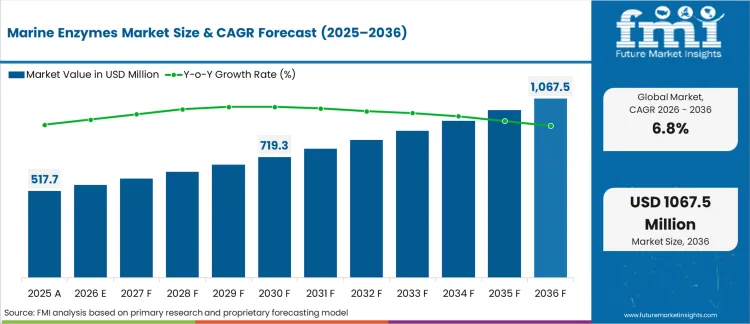
Marine Enzymes Market Outlook
The global marine enzymes market is entering a decisive growth phase as demand accelerates across pharmaceuticals, biotechnology, environmental remediation, and functional food applications. According to insights published by Future Market Insights, the market was valued at USD 517.7 million in 2025 and is projected to grow to USD 552.9 million in 2026. By 2036, revenues are expected to reach USD 1,068.5 million, reflecting a robust CAGR of 6.8% over the forecast period.
This trajectory translates into an absolute dollar opportunity of USD 550.8 million over the next decade—signaling transformative potential for stakeholders positioned within high-value biotechnological niches.
Marine Biodiversity Unlocking Biotechnological Value
Marine ecosystems represent one of the most underexplored biological reservoirs on Earth. Enzymes derived from marine microorganisms, algae, and invertebrates are increasingly recognized for their:
- High catalytic efficiency
- Stability under extreme pH and temperature conditions
- Unique substrate specificity
These properties make marine enzymes especially valuable in pharmaceutical synthesis, molecular diagnostics, and industrial bioprocessing where conventional enzymes often underperform.
Unlike terrestrial enzymes, marine-derived variants are naturally adapted to saline and high-pressure environments. This resilience enables superior functionality in complex biochemical formulations—particularly in next-generation drug development and biologics manufacturing.
Pharmaceutical Innovation at the Core of Demand
The pharmaceutical sector remains the primary revenue contributor to the marine enzymes market. Enzymes such as marine proteases, lipases, and polymerases are being increasingly integrated into:
- Drug formulation processes
- Targeted therapy development
- Enzyme-based therapeutics
- Cancer and metabolic disorder research
Growing global healthcare expenditure and rapid advances in precision medicine are accelerating adoption. Biopharmaceutical companies are investing in specialized marine bioprospecting programs to identify novel bioactive compounds with therapeutic potential.
As regulatory authorities emphasize sustainable and high-purity production methods, marine enzymes offer scalable and efficient catalytic solutions, further strengthening their role in pharmaceutical manufacturing pipelines.
"Access the Industry Blueprint: Download Sample or Buy Full Analysis."
Expanding Role in Bioremediation and Environmental Applications
Environmental sustainability is emerging as a significant growth catalyst. Marine enzymes are being deployed in bioremediation initiatives to address oil spills, industrial effluents, and plastic degradation.
Their ability to function effectively in saline and contaminated aquatic environments makes them ideal for large-scale environmental cleanup operations. Governments and environmental agencies worldwide are prioritizing biologically driven remediation solutions over chemical treatments, contributing to sustained market expansion.
The intersection of biotechnology and environmental policy reform is expected to create new commercial opportunities for enzyme manufacturers through public-private partnerships and sustainability-driven procurement programs.
Functional Food and Nutraceutical Integration
The functional food industry is another promising application segment. Marine-derived enzymes are increasingly incorporated into dietary supplements and fortified foods to enhance digestion, nutrient absorption, and metabolic efficiency.
With global consumers shifting toward preventive healthcare and clean-label products, food manufacturers are exploring marine bioactives as differentiated ingredients. Their natural origin and unique biochemical profiles align well with evolving consumer preferences for marine-sourced wellness products.
As nutraceutical innovation continues, enzyme-enhanced formulations are expected to capture premium market segments, particularly in Asia-Pacific and North America.
Strategic Growth Drivers
Several structural factors are underpinning the projected 6.8% CAGR:
- Rising investment in marine biotechnology research
- Expansion of global biopharmaceutical production capacity
- Increased demand for sustainable industrial catalysts
- Technological advancements in enzyme purification and stabilization
Major producers are leveraging proprietary extraction and purification technologies to improve yield efficiency and reduce downstream processing costs. These capabilities enable premium pricing in high-margin pharmaceutical and biotech applications.
Market Challenges and Regulatory Complexities
Despite promising growth prospects, the market faces certain constraints.
High enzyme extraction and purification costs remain a key operational challenge. Marine bioprospecting requires advanced research infrastructure, controlled harvesting processes, and compliance with biodiversity conservation protocols.
Additionally, regulatory frameworks governing marine genetic resource access—particularly under international biodiversity agreements—introduce complexity in cross-border commercialization. Companies must navigate evolving compliance standards while maintaining ethical sourcing practices.
However, established enzyme manufacturers with integrated R&D capabilities and strategic marine partnerships continue to sustain competitive advantage through innovation-driven differentiation.
Regional Outlook and Competitive Landscape
North America and Europe currently lead in marine enzyme commercialization due to advanced pharmaceutical infrastructure and strong research ecosystems. Meanwhile, Asia-Pacific is emerging as a high-growth region, driven by expanding biotech industries and marine biodiversity access.
Leading market participants are investing in:
- Collaborative research agreements
- Advanced fermentation technologies
- Marine microbial genomics
- Sustainable harvesting and aquaculture-based enzyme sourcing
These strategic initiatives are expected to enhance production scalability and accelerate product innovation pipelines over the next decade.
A Decade of Transformational Opportunity
The marine enzymes market stands at the convergence of biotechnology, sustainability, and pharmaceutical innovation. With revenues projected to surpass USD 1.06 billion by 2036, the sector presents substantial long-term value creation potential.
As research institutions and commercial producers deepen exploration of marine biodiversity, novel enzyme discoveries are likely to unlock entirely new therapeutic and industrial applications.
Backed by a projected USD 550.8 million absolute dollar expansion, marine enzymes are poised to move from niche bioactive components to mainstream biotechnological catalysts—reshaping pharmaceutical development, environmental remediation, and functional nutrition on a global scale.
Why FMI: https://www.futuremarketinsights.com/why-fmi
About Future Market Insights (FMI)
Future Market Insights (FMI) is a leading provider of market intelligence and consulting services, serving clients in over 150 countries. Headquartered in Delaware, USA, with a global delivery center in India and offices in the UK and UAE, FMI delivers actionable insights to businesses across industries including automotive, technology, consumer products, manufacturing, energy, and chemicals.
An ESOMAR-certified research organization, FMI provides custom and syndicated market reports and consulting services, supporting both Fortune 1,000 companies and SMEs. Its team of 300+ experienced analysts ensures credible, data-driven insights to help clients navigate global markets and identify growth opportunities.
Contact Us:
Future Market Insights Inc.
Christiana Corporate, 200 Continental Drive,
Suite 401, Newark, Delaware - 19713, USA
T: +1-347-918-3531
For Sales Enquiries: sales@futuremarketinsights.com

 Arabic
 French
 Spanish
 Portuguese
 Deutsch
 Turkish
 Dutch
Dutch
 Italiano
 Russian
 Romaian
 Brasiliano
 Greek
Greek