
Animal Feed Ingredients Market Industry Forecast: USD 60.2 Billion Valuation by 2035
Global Animal Feed Ingredients Market Outlook
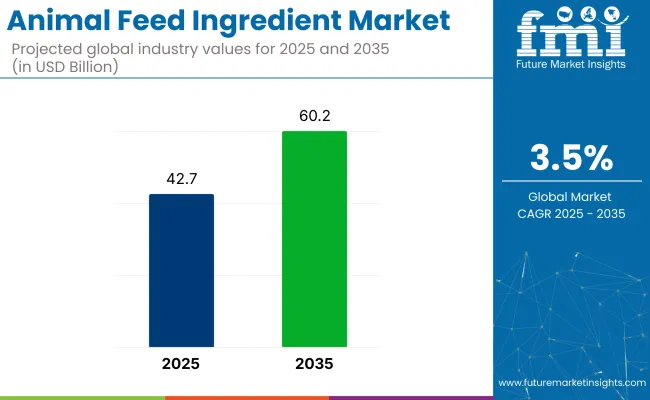
The global animal feed ingredients market is entering a decade of stable and value-driven expansion. Valued at approximately USD 42.7 billion in 2025, the market is projected to reach USD 60.2 billion by 2035, registering a steady CAGR of 3.5%. This sustained growth reflects the rising strategic importance of high-quality feed ingredients—particularly protein-based components—in supporting productivity, animal health, and global food security.
As livestock, poultry, and aquaculture systems scale to meet increasing global demand for meat, dairy, and seafood products, feed efficiency and nutritional optimization have become central to farm profitability. Feed ingredients are no longer viewed as simple inputs but as performance-enhancing solutions that directly influence yield, disease resistance, and overall production economics.
Rising protein consumption worldwide is driving structural changes in animal production systems. Developing economies across Asia-Pacific, Latin America, and parts of Africa are witnessing rapid urbanization and income growth, which is accelerating demand for animal-derived protein. To meet these evolving dietary patterns, producers are focusing on nutritionally balanced feed formulations enriched with amino acids, oilseed meals, and specialty protein ingredients.
Protein-based feed components such as soybean meal, fishmeal, and alternative plant proteins are gaining prominence due to their high digestibility and essential amino acid profiles. These ingredients play a crucial role in improving feed conversion ratios, ensuring faster growth cycles, and enhancing reproductive performance across species.
In addition to protein enrichment, the industry is witnessing a broader transformation driven by innovation and sustainability. Feed manufacturers are investing in precision nutrition strategies and advanced formulation technologies to reduce waste, lower environmental impact, and optimize cost structures. This approach aligns with global regulatory trends emphasizing sustainable livestock production and reduced greenhouse gas emissions.
Several structural drivers are shaping the market’s long-term trajectory:
- Increasing global demand for animal protein
- Growing awareness of feed quality and animal health management
- Expansion of aquaculture and commercial poultry operations
- Technological advancements in feed processing and ingredient optimization
Aquaculture, in particular, represents a high-growth segment. With wild fish stocks under pressure and seafood consumption rising, aquafeed demand is expanding steadily. Specialized ingredients designed to enhance water stability, digestibility, and nutrient absorption are playing a critical role in supporting sustainable fish farming practices.
Meanwhile, poultry continues to dominate feed consumption volumes due to its shorter production cycles and relatively lower production costs compared to red meat. Feed ingredient innovations aimed at improving gut health and immunity are gaining traction in poultry operations worldwide.
Regionally, Asia-Pacific remains the largest and fastest-growing market, driven by high livestock populations and expanding aquaculture activities. North America and Europe continue to focus on premium, specialty, and functional feed ingredients, supported by advanced farming practices and regulatory oversight. Latin America is emerging as a significant contributor, particularly in soybean-based feed ingredient production.
Sustainability has emerged as a defining theme across the industry. Stakeholders are increasingly prioritizing alternative protein sources, including insect meal, algae-based ingredients, and fermentation-derived proteins, as viable solutions to reduce reliance on traditional fishmeal and soy. These innovations aim to balance nutritional efficiency with environmental responsibility.
The industry is also navigating challenges such as raw material price volatility, climate-related crop disruptions, and geopolitical trade uncertainties. However, ongoing research, supply chain diversification, and digitalization in feed management systems are helping mitigate these risks.
Over the next decade, growth is expected to be incremental yet resilient, supported by consistent global protein demand and advancements in animal nutrition science. Market participants that invest in innovation, traceability, and sustainability are likely to secure competitive advantage in this evolving landscape.
Looking ahead to 2035, the animal feed ingredients market size will increasingly reflect a shift toward precision, performance, and environmental accountability. As feed efficiency becomes synonymous with profitability and sustainability, ingredient quality and formulation expertise will remain central to long-term industry growth.
Frequently Asked Questions (FAQs)
What is driving growth in the global animal feed ingredients market?
Growth is primarily driven by rising global demand for animal protein, increasing livestock and aquaculture production, and the need for nutritionally optimized feed formulations that improve productivity and animal health.
What is the projected market size by 2035?
The market is expected to reach USD 60.2 billion by 2035, expanding from USD 42.7 billion in 2025 at a CAGR of 3.5%.
Why are protein-based feed ingredients gaining importance?
Protein-based ingredients such as soybean meal and fishmeal provide essential amino acids that enhance growth rates, feed conversion efficiency, and overall livestock performance.
Which region dominates the market?
Asia-Pacific holds a leading position due to its large livestock base, growing aquaculture sector, and rising demand for animal protein products.
How is sustainability influencing the industry?
Sustainability is driving the adoption of alternative protein sources, improved feed efficiency technologies, and environmentally responsible sourcing practices to reduce emissions and resource use.
What challenges does the market face?
Key challenges include raw material price volatility, climate impacts on crop production, supply chain disruptions, and regulatory compliance requirements.
The global animal feed ingredients market stands at the intersection of nutrition science, sustainability, and food security—positioning it as a critical enabler of the future global protein economy.
👉 Get Access to the Report Sample:
Why FMI: https://www.futuremarketinsights.com/why-fmi
About Future Market Insights (FMI)
Future Market Insights (FMI) is a leading provider of market intelligence and consulting services, serving clients in over 150 countries. Headquartered in Delaware, USA, with a global delivery center in India and offices in the UK and UAE, FMI delivers actionable insights to businesses across industries including automotive, technology, consumer products, manufacturing, energy, and chemicals.
An ESOMAR-certified research organization, FMI provides custom and syndicated market reports and consulting services, supporting both Fortune 1,000 companies and SMEs. Its team of 300+ experienced analysts ensures credible, data-driven insights to help clients navigate global markets and identify growth opportunities.
Contact Us:
Future Market Insights Inc.
Christiana Corporate, 200 Continental Drive,
Suite 401, Newark, Delaware - 19713, USA
T: +1-347-918-3531
For Sales Enquiries: sales@futuremarketinsights.com

 English
 French
 Spanish
 Portuguese
 Deutsch
 Turkish
 Dutch
Dutch
 Italiano
 Russian
 Romaian
 Brasiliano
 Greek
Greek