
Fortified Milk and Milk Products Market Pricing Strategy and Revenue Outlook 2036
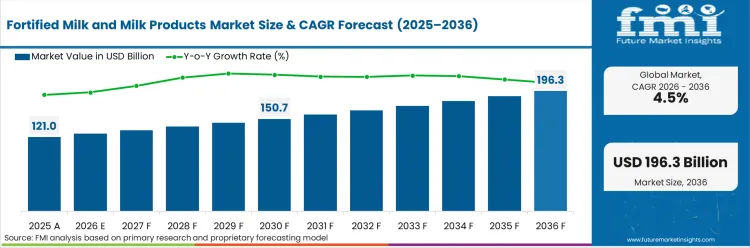
Global Fortified Milk and Milk Products Market Outlook
The global fortified milk and milk products market is entering a decisive growth cycle, transitioning from voluntary enrichment initiatives to compliance-driven nutritional standardization. According to the latest analysis by Future Market Insights (FMI), the market was valued at USD 120.9 billion in 2025 and is estimated to reach USD 126.4 billion in 2026. Over the next decade, revenues are projected to expand to USD 202.2 billion by 2036, registering a steady CAGR of 4.5%.
The absolute dollar opportunity of USD 75.8 billion between 2026 and 2036 underscores structural transformation across dairy processing ecosystems. Fortification is no longer a premium differentiation strategy—it is rapidly becoming a regulatory baseline in several national nutrition frameworks.
Fortified milk and milk products refer to standardized dairy matrices enriched with synthetic micronutrients to address systemic deficiencies. Processors incorporate stabilized vitamins and minerals into liquid, powdered, and cultured dairy formats prior to homogenization and packaging. These formulations increasingly target pediatric anemia, skeletal fragility, immune deficiencies, and age-related nutritional gaps.
Capital Investments and Compliance Cycles Accelerate
FMI analysis indicates that processors are entering immediate capital expenditure cycles to integrate precision dosing systems on high-speed liquid lines. The shift toward mandated baseline inclusion rules requires strict tolerance margins, pushing manufacturers to deploy spectroscopic validation systems and real-time quality monitoring technologies.
Nandini Roy Choudhury, Principal Consultant for Food & Beverage at FMI, notes, “Producers must bypass commoditization by embedding precise premix technologies directly into high-volume pediatric pipelines. Compliance agility will define long-term market leadership.”
Strategic imperatives include:
- Upgrading legacy homogenization systems to manage iron suspensions and fat-soluble compounds.
- Partnering with pharmaceutical-grade premix suppliers to stabilize bioavailability.
- Aligning retail positioning with verified regional deficiency clusters.
Segment Dynamics: Vitamins and Liquid Milk Lead
Vitamins dominate the micronutrient segment, capturing 35.0% share in 2026. Regulatory agencies are revising permissible dosing thresholds to accelerate recovery from persistent public health deficits. Stabilized vitamin D, B-complex blends, and iron infusions are central to pediatric and maternal nutrition interventions.
By product type, liquid milk commands 20.1% share in 2026. Standardized fluid matrices provide ideal emulsion stability for synthetic additions, making milk the preferred vehicle for nutrient delivery across institutional feeding networks.
Modern trade channels account for 32.0% of market movement in 2026, supported by temperature-controlled infrastructure and private label expansions. Retailers increasingly dictate formulation standards to align with national dietary guidelines, placing pressure on manufacturers to ensure label-to-formulation accuracy.
Regional Growth Anchored in Public Health Priorities
Demand trajectories vary according to baseline health metrics and domestic dairy output capacities.
India is projected to expand at a 6.2% CAGR through 2036, supported by large-scale production capabilities and aggressive government-backed nutrition initiatives. According to the Government of India’s Department of Animal Husbandry and Dairying, national milk production reached 239.30 million tonnes in 2023–2024, ensuring robust raw material availability for fortification programs.
China is forecast to grow at 5.5% CAGR, driven by pediatric health concerns and strong urban acceptance of premium functional dairy claims.
In Europe, the United Kingdom and France are expected to register CAGRs of 4.7% and 4.2% respectively, as mature fluid categories shift toward calibrated enrichment tiers.
The United States is projected to grow at 3.9% CAGR through 2036. Regulatory updates permitting higher vitamin D3 inclusion levels in yogurt formats are enabling manufacturers to reposition fortified dairy as direct substitutes for supplement categories.
Market Drivers and Structural Constraints
Government-subsidized feeding programs remain a primary growth catalyst. The World Health Organization reports persistent global anemia rates, intensifying policy-driven dairy procurement for institutional distribution. Similarly, data from UNICEF highlights expanding adoption of enriched breakfast staples across vulnerable populations.
However, margin compression remains a challenge. Volatile international pricing for synthetic vitamins and minerals complicates procurement strategies. Processors are increasingly adopting fat-filled milk powder formats to optimize storage stability and reduce spoilage risks during commodity price fluctuations.
Competitive Landscape: Reformulation Speed as Differentiator
Global leaders are aggressively repositioning portfolios. Nestlé S.A. continues to prioritize volume- and mix-led growth through enhanced nutritional offerings. Danone S.A. reported fortifying 100% of its kids’ dairy portfolios in key markets with vitamin D and B6.
Regional operators such as Mother Dairy have launched specialized fortified variants targeting daily consumption segments. Meanwhile, FrieslandCampina and Arla Foods focus on advanced masking technologies to maintain sensory stability while increasing micronutrient loads.
Speed in reformulation and compliance verification now determines retail shelf access. Hypermarket operators impose stringent private label sourcing norms, and non-compliant brands face rapid delisting.
Methodology and Data Integrity
FMI’s analysis is built on hybrid top-down and bottom-up modeling validated through direct interviews with dairy cooperative managers, premix suppliers, and clinical nutrition specialists. Market sizing reconciles raw fluid output benchmarks against verified premix consumption ratios, with cross-validation against quarterly disclosures from multinational dairy corporations.
👉 Unlock In-Depth Market Intelligence — Access the Full Report Now: https://www.futuremarketinsights.com/reports/fortified-milk-and-milk-products-market
Frequently Asked Questions (FAQs)
How large is the fortified milk and milk products market in 2026?
The market is estimated at USD 126.4 billion in 2026.
What will the market size reach by 2036?
Global revenues are projected to reach USD 202.2 billion by 2036.
What is the expected CAGR between 2026 and 2036?
The market is forecast to grow at 4.5% CAGR during the period.
Which micronutrient segment leads in 2026?
Vitamins are expected to dominate with 35.0% share due to widespread clinical intervention programs.
Which product type drives adoption?
Liquid milk leads with 20.1% share, supported by superior nutrient dispersion stability.
Which country shows the fastest growth?
India leads with a projected CAGR of 6.2% through 2036.
Why FMI: https://www.futuremarketinsights.com/why-fmi
About Future Market Insights (FMI)
Future Market Insights (FMI) is a leading provider of market intelligence and consulting services, serving clients in over 150 countries. Headquartered in Delaware, USA, with a global delivery center in India and offices in the UK and UAE, FMI delivers actionable insights to businesses across industries including automotive, technology, consumer products, manufacturing, energy, and chemicals.
An ESOMAR-certified research organization, FMI provides custom and syndicated market reports and consulting services, supporting both Fortune 1,000 companies and SMEs. Its team of 300+ experienced analysts ensures credible, data-driven insights to help clients navigate global markets and identify growth opportunities.
Contact Us:
Future Market Insights Inc.
Christiana Corporate, 200 Continental Drive,
Suite 401, Newark, Delaware - 19713, USA
T: +1-347-918-3531
For Sales Enquiries: sales@futuremarketinsights.com

 English
 Arabic
 French
 Spanish
 Portuguese
 Deutsch
 Turkish
 Italiano
 Russian
 Romaian
 Brasiliano
 Greek
Greek