
Fish Meal Market Investment Opportunities in a Supply-Constrained Era
Global Fish Meal Market Outlook
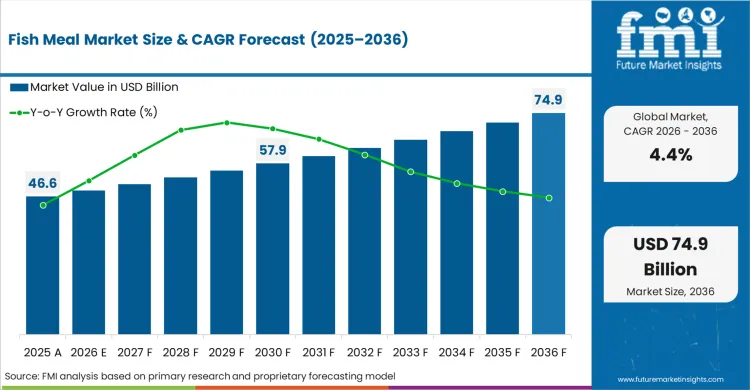
The global fish meal market is entering a decade defined less by volume expansion and more by value optimization. In 2025, the market was valued at USD 46.6 billion. It is projected to grow to USD 48.7 billion in 2026 and further expand to USD 74.8 billion by 2036, reflecting a steady CAGR of 4.4%.
Over the ten-year forecast period, the industry is expected to generate an absolute dollar growth of USD 26.2 billion. Unlike high-volume commodity cycles, this expansion is being driven primarily by supply limitations and pricing strength rather than dramatic increases in catch volumes.
A Structural Shift Toward Value Rather Than Volume
Fish meal production is inherently dependent on wild-catch fisheries, which remain finite due to regulatory quotas, environmental pressures, and sustainability frameworks. As a result, supply growth remains structurally capped.
This constraint is reshaping market dynamics.
Instead of expanding output indiscriminately, marine resources are increasingly allocated to high-margin aquaculture applications. The shift reflects a strategic reprioritization where fish meal is directed toward species with higher economic return, such as salmon, shrimp, and marine finfish, rather than lower-value livestock feed applications.
This value-focused redistribution explains why market revenues are rising even as raw material availability remains relatively stable.
Pricing Power Strengthens Market Fundamentals
Limited raw material supply, coupled with growing aquaculture demand, is reinforcing pricing resilience. Fish meal prices have historically shown sensitivity to El Niño patterns and regional catch disruptions, particularly in key producing countries such as Peru and Chile. However, sustained demand from aquafeed manufacturers is cushioning volatility.
The projected CAGR of 4.4% signals moderate but dependable expansion, underpinned by:
- Tight wild-catch quotas
- Stable aquaculture feed demand
- Strong protein inclusion rates in premium aquafeed
- Growing global seafood consumption
As aquaculture continues to supply an increasing share of global seafood production, high-protein feed ingredients like fish meal remain critical.
Aquaculture: The Core Demand Engine
Aquaculture is the primary driver behind the projected USD 74.8 billion valuation by 2036. Farmed fish and shrimp require high-quality protein and essential amino acids to ensure optimal growth rates and feed conversion efficiency.
"Access the Industry Blueprint: Download Sample or Buy Full Analysis."
Fish meal remains difficult to fully replace due to its:
- Superior digestibility
- Balanced amino acid profile
- High palatability
- Rich omega-3 content
While plant-based alternatives such as soybean meal and insect protein are gaining attention, partial substitution remains more realistic than full displacement in premium aquaculture segments.
As global seafood consumption rises—driven by health-conscious diets and population growth—the aquafeed industry will continue to prioritize performance-based feed formulations.
Regional Supply Concentration and Strategic Importance
The fish meal industry remains geographically concentrated. South America, particularly Peru, accounts for a substantial share of global production. This concentration amplifies the market’s exposure to climatic patterns and regulatory decisions.
At the same time, Asia-Pacific dominates consumption, especially China, which represents one of the largest importers of fish meal for aquafeed manufacturing.
This production-consumption imbalance creates a global trade ecosystem that reinforces pricing stability and international market interdependence.
Sustainability and Regulatory Influence
Environmental governance is playing an increasingly significant role in shaping market outlook. Sustainable fishery certifications and traceability requirements are now embedded into procurement strategies across leading aquafeed producers.
The next decade is expected to see:
- Stricter marine resource management
- Expanded certification programs
- Increased monitoring of bycatch and ecosystem impact
- Greater transparency across supply chains
Rather than constraining growth, these frameworks may strengthen long-term price realization by preserving resource availability and ensuring premium positioning.
Margin Optimization Over Expansion
With wild-catch volumes largely capped, industry participants are focusing on operational efficiency and yield optimization. Processing technology upgrades are helping improve extraction rates from raw fish inputs, maximizing protein recovery.
Additionally, by-product utilization—such as converting fish processing waste into fish meal—offers incremental supply without increasing fishing pressure.
This strategic emphasis on efficiency aligns with the market’s value-driven trajectory.
Competitive Landscape and Innovation
Market participants are investing in improved drying technologies, quality grading systems, and enhanced storage infrastructure to maintain nutritional consistency. Buyers in aquaculture are increasingly demanding traceable, high-protein grades that deliver measurable feed performance outcomes.
Innovation is also emerging in blended feed formulations where fish meal is combined with alternative proteins to optimize cost-performance ratios without compromising growth metrics.
Outlook: A Decade of Controlled Expansion
The projected rise from USD 46.6 billion in 2025 to USD 74.8 billion by 2036 reflects a structurally stable growth path. The absolute dollar increase of USD 26.2 billion highlights how constrained supply environments can generate sustained value appreciation.
Why FMI: https://www.futuremarketinsights.com/why-fmi
About Future Market Insights (FMI)
Future Market Insights (FMI) is a leading provider of market intelligence and consulting services, serving clients in over 150 countries. Headquartered in Delaware, USA, with a global delivery center in India and offices in the UK and UAE, FMI delivers actionable insights to businesses across industries including automotive, technology, consumer products, manufacturing, energy, and chemicals.
An ESOMAR-certified research organization, FMI provides custom and syndicated market reports and consulting services, supporting both Fortune 1,000 companies and SMEs. Its team of 300+ experienced analysts ensures credible, data-driven insights to help clients navigate global markets and identify growth opportunities.
Contact Us:
Future Market Insights Inc.
Christiana Corporate, 200 Continental Drive,
Suite 401, Newark, Delaware - 19713, USA
T: +1-347-918-3531
For Sales Enquiries: sales@futuremarketinsights.com

 English
 Arabic
 French
 Spanish
 Portuguese
 Deutsch
 Turkish
 Italiano
 Russian
 Romaian
 Brasiliano
 Greek
Greek