
Malt Ingredients Market Analysis by Type, Application & Region
Malt Ingredients Market Outlook
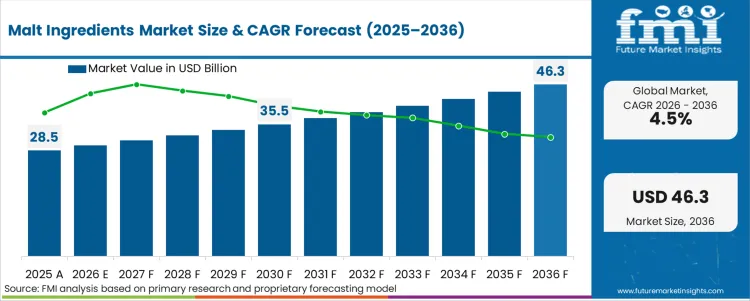
According to analysis by Future Market Insights (FMI), the malt ingredients market size crossed a valuation of USD 28.5 billion in 2025. Demand is projected to rise to USD 29.8 billion in 2026 and reach USD 52.5 billion by 2036, reflecting a consistent CAGR of 4.5% over the forecast period.
This translates into an absolute dollar opportunity of USD 24.0 billion between 2026 and 2036—signaling structural, not speculative, growth.
Brewing Remains the Anchor, but Diversification Is Accelerating
Malt ingredients—derived primarily from barley, wheat, and other cereals—continue to be foundational to global brewing. Beer production accounts for a significant share of malt utilization, particularly specialty and craft variants that demand unique flavor profiles.
However, the growth narrative is no longer limited to alcoholic beverages.
Food manufacturers are increasingly incorporating malt extracts, flours, and syrups into bakery, confectionery, ready-to-eat cereals, dairy products, and plant-based formulations. Malt’s natural sweetness, enzymatic activity, and flavor-enhancing characteristics make it a multifunctional ingredient.
This diversification is insulating the market from cyclical fluctuations in beer consumption while broadening application scope.
Craft Brewing and Premiumization Drive Value Growth
Premiumization continues to influence malt demand patterns. Craft brewers are sourcing specialty malts to create differentiated flavor notes, colors, and textures.
Global players such as Cargill and Malteurop are expanding specialty malt portfolios to cater to evolving brewer specifications. Meanwhile, large-scale brewers including Anheuser-Busch InBev are investing in product innovation to maintain premium positioning across mature markets.
This shift toward premium and specialty variants enhances average selling prices, contributing to revenue expansion even where volume growth is moderate.
"Access the Industry Blueprint: Download Sample or Buy Full Analysis."
Clean-Label and Natural Ingredient Positioning
Malt ingredients benefit from strong alignment with clean-label trends. As consumers scrutinize ingredient lists more closely, naturally derived sweeteners and flavor enhancers are gaining preference over synthetic alternatives.
Malt extract is increasingly used as:
- A natural sweetening agent in cereals and snack bars
- A fermentation substrate in bakery products
- A color and flavor enhancer in sauces and beverages
Its recognizable origin and minimal processing profile strengthen its positioning in “free-from artificial additives” formulations.
This alignment with health-conscious consumer behavior is expected to support sustained demand growth through 2036.
Regional Growth Patterns
Europe remains a mature yet innovation-driven market due to its strong brewing heritage. Germany, France, and the UK continue to anchor production and export activity.
North America demonstrates steady growth supported by craft brewing resilience and expanding food applications. Meanwhile, Asia-Pacific is emerging as a high-potential region, driven by urbanization, rising disposable incomes, and expanding beer consumption in countries such as China, India, and Vietnam.
In developing economies, increasing westernization of diets and growth in processed foods are also driving incremental malt demand in bakery and convenience food segments.
Supply Chain and Raw Material Considerations
Barley availability remains a critical determinant of malt production capacity. Climate variability, geopolitical trade dynamics, and agricultural yield fluctuations influence pricing stability.
Producers are responding through:
- Strategic barley sourcing agreements
- Investment in sustainable farming practices
- Geographic diversification of procurement networks
Sustainability is also becoming a procurement priority for large beverage manufacturers. Reduced water consumption, carbon footprint transparency, and regenerative agriculture programs are increasingly integrated into supplier selection frameworks.
This evolving procurement landscape reinforces long-term supplier partnerships and operational resilience.
Functional and Nutritional Applications Expand Market Scope
Beyond brewing and bakery, malt ingredients are gaining traction in functional food and nutraceutical applications.
Malted barley and wheat contain enzymes, vitamins, and bioactive compounds that support digestive health and metabolic processes. As consumers gravitate toward foods perceived as “naturally functional,” malt-derived components are being explored in fortified snacks, health drinks, and sports nutrition blends.
This intersection of tradition and functionality strengthens malt’s relevance across multiple consumer segments.
Pricing Stability and Margin Outlook
With a projected CAGR of 4.5%, the malt ingredients market reflects moderate but dependable expansion. The industry benefits from established demand in brewing, balanced by incremental gains in diversified food categories.
Margin performance will depend on:
- Raw material cost volatility
- Energy pricing trends
- Transportation and logistics efficiency
- Premium product mix expansion
Producers that move up the value chain into specialty malts and tailored ingredient solutions are expected to outperform commodity-focused competitors.
Outlook to 2036: Resilient, Diversified, and Innovation-Led
By 2036, global malt ingredient revenues are forecast to reach USD 52.5 billion, nearly doubling from 2025 levels.
The growth trajectory reflects a market transitioning from reliance on traditional beer demand to a more diversified, innovation-driven ecosystem. Specialty brewing, clean-label reformulation, functional foods, and sustainability initiatives collectively reinforce long-term resilience.
Rather than explosive expansion, the malt ingredients sector represents stable, compounding growth—anchored by centuries-old brewing heritage yet continuously evolving to meet modern consumer expectations.
For stakeholders across agriculture, processing, beverage manufacturing, and packaged foods, the message is clear: malt is no longer just a brewing staple. It is an adaptable, multifunctional ingredient positioned at the intersection of flavor, functionality, and transparency in the global food system.
Why FMI: https://www.futuremarketinsights.com/why-fmi
About Future Market Insights (FMI)
Future Market Insights (FMI) is a leading provider of market intelligence and consulting services, serving clients in over 150 countries. Headquartered in Delaware, USA, with a global delivery center in India and offices in the UK and UAE, FMI delivers actionable insights to businesses across industries including automotive, technology, consumer products, manufacturing, energy, and chemicals.
An ESOMAR-certified research organization, FMI provides custom and syndicated market reports and consulting services, supporting both Fortune 1,000 companies and SMEs. Its team of 300+ experienced analysts ensures credible, data-driven insights to help clients navigate global markets and identify growth opportunities.
Contact Us:
Future Market Insights Inc.
Christiana Corporate, 200 Continental Drive,
Suite 401, Newark, Delaware - 19713, USA
T: +1-347-918-3531
For Sales Enquiries: sales@futuremarketinsights.com

 English
 Arabic
 French
 Spanish
 Portuguese
 Deutsch
 Turkish
 Dutch
Dutch
 Italiano
 Russian
 Romaian
 Brasiliano