
Calcium Propionate Market Expansion Fueled by Bakery & Feed Applications
Calcium Propionate Market Outlook
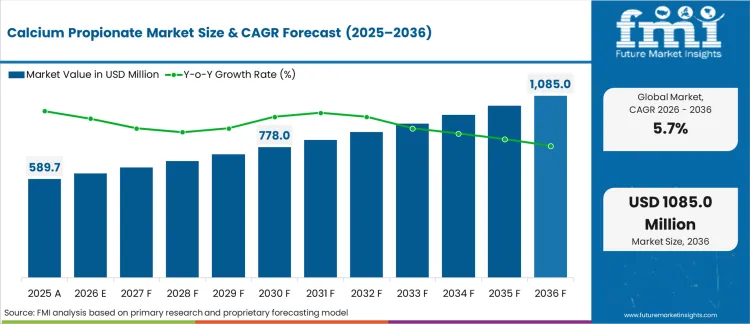
The global calcium propionate market is entering a phase of steady, structurally supported growth as food waste reduction, shelf-life optimization, and supply chain efficiency move to the center of procurement strategy. According to insights from Future Market Insights (FMI), the market surpassed USD 589.6 million in 2025 and is projected to reach USD 623.3 million in 2026. By 2036, revenues are forecast to climb to USD 1,082.4 million, reflecting a CAGR of 5.7% during the assessment period.
This expansion represents an absolute dollar opportunity of nearly USD 493 million over the next decade — a signal that calcium propionate is transitioning from a routine preservative to a strategic waste-mitigation tool within global food systems.
Food Waste Economics Driving Demand
The growth narrative is closely tied to global food waste statistics. In the United States alone, approximately 31% of the food supply is lost or wasted across the value chain. Such inefficiencies are no longer viewed solely as sustainability concerns; they are financial liabilities.
Producers and retailers are under mounting pressure to extend product shelf life, reduce spoilage losses, and optimize logistics. Calcium propionate, widely used as a mold inhibitor in bakery and dairy products, plays a central role in meeting these objectives.
Longer shelf stability enables:
- Reduced product returns in retail channels
- Lower write-offs due to spoilage
- Greater flexibility in cross-border distribution
- Improved inventory turnover efficiency
As global supply chains stretch across continents, preservatives that stabilize product quality over extended transportation cycles are becoming indispensable.
Bakery Sector as the Core Demand Anchor
The bakery segment remains the primary revenue contributor to the calcium propionate market. Bread, buns, tortillas, and packaged baked goods are highly susceptible to mold growth, particularly in humid climates and emerging markets with extended retail storage times.
With urbanization accelerating and demand for packaged convenience foods rising across Asia-Pacific, Latin America, and parts of Africa, bakery output continues to expand. This volume growth directly supports steady preservative consumption.
In developed economies, reformulation efforts are not eliminating preservatives but optimizing their usage levels to align with clean-label expectations while maintaining safety compliance.
Upstream Pricing and Raw Material Fundamentals
Calcium propionate production is closely linked to propionic acid supply dynamics. Upstream fluctuations in petrochemical feedstock influence baseline pricing structures across high-volume production corridors.
Buyers increasingly balance:
- Raw material volatility
- Long-term supply contracts
- Regulatory thresholds for inclusion rates
- Final product margin targets
Procurement strategies are shifting from spot purchasing toward integrated supplier partnerships, ensuring predictable availability and cost control.
As food manufacturers seek resilience against commodity shocks, preservative inputs with stable production economics gain preference.
Regulatory and Safety Compliance Reinforcing Market Stability
Calcium propionate remains widely approved by food safety authorities across major markets. Its established regulatory acceptance provides manufacturers with compliance certainty, especially compared to emerging alternative preservatives that may face evolving approval pathways.
In an environment of heightened scrutiny around food additives, proven safety records become a competitive advantage. Manufacturers prefer ingredients with decades of toxicological validation and globally harmonized usage guidelines. This regulatory clarity underpins the 5.7% CAGR projection through 2036.
"Access the Industry Blueprint: Download Sample or Buy Full Analysis."
Balancing Clean Label and Shelf Life
One of the market’s defining tensions lies in the clean-label movement. Consumers increasingly scrutinize ingredient lists, favoring simplicity and transparency. However, extended shelf life remains non-negotiable for retailers and foodservice operators.
Rather than eliminating preservatives outright, manufacturers are focusing on:
- Optimizing dosage precision
- Pairing preservatives with improved packaging technologies
- Communicating functionality transparently
The result is not contraction but strategic refinement. Calcium propionate’s functional necessity in preventing microbial spoilage ensures continued demand, even as labeling practices evolve.
Emerging Markets and Distribution Expansion
Emerging economies represent a critical growth frontier. Expanding supermarket penetration, rising disposable incomes, and growth in organized retail are increasing reliance on packaged baked goods.
Longer distribution routes in these regions heighten the importance of mold inhibition. As cold chain infrastructure remains uneven in parts of the developing world, preservatives provide an essential buffer against climate variability.
This structural demand underpins volume consistency across regional markets.
Outlook: Operational Efficiency as the Growth Engine
With revenues expected to rise from USD 589.6 million in 2025 to USD 1,082.4 million by 2036, calcium propionate’s growth story is defined by operational pragmatism rather than consumer trend cycles.
A CAGR of 5.7% reflects stable integration into high-volume food manufacturing systems. The nearly USD 493 million absolute dollar increase underscores the ingredient’s expanding role in waste reduction and profitability protection.
Why FMI: https://www.futuremarketinsights.com/why-fmi
About Future Market Insights (FMI)
Future Market Insights (FMI) is a leading provider of market intelligence and consulting services, serving clients in over 150 countries. Headquartered in Delaware, USA, with a global delivery center in India and offices in the UK and UAE, FMI delivers actionable insights to businesses across industries including automotive, technology, consumer products, manufacturing, energy, and chemicals.
An ESOMAR-certified research organization, FMI provides custom and syndicated market reports and consulting services, supporting both Fortune 1,000 companies and SMEs. Its team of 300+ experienced analysts ensures credible, data-driven insights to help clients navigate global markets and identify growth opportunities.
Contact Us:
Future Market Insights Inc.
Christiana Corporate, 200 Continental Drive,
Suite 401, Newark, Delaware - 19713, USA
T: +1-347-918-3531
For Sales Enquiries: sales@futuremarketinsights.com

 English
 Arabic
 French
 Spanish
 Portuguese
 Deutsch
 Turkish
 Dutch
Dutch
 Italiano
 Russian
 Romaian
 Greek
Greek